




When evaluating education technology platforms, many institutions compare a Student Information System (SIS) and a Learning Management System (LMS). While both play important roles in education, they serve different purposes. A student information system manages student records, enrollment, attendance, grades, and administrative operations, while a learning management system focuses on course delivery, assessments, student engagement, and online learning.
Understanding the difference between SIS vs LMS helps schools, colleges, and universities choose the right technology stack. In this guide, we’ll compare SIS and LMS platforms, explain their key differences, explore how they work together, and help you determine whether your institution needs one or both systems.
What Is a Student Information System (SIS)
The Student Information System (SIS) is the main part of the administration of any school. It works like a database where you can keep track of and manage all the information about students. SIS keeps track of student records, grades, enrollment, fees, attendance, schedules, and compliance data. SIS systems let administrators, teachers, students, and parents all access this information from one place.
SIS Features
Here’s what you can typically expect from SIS platforms:
- SIS keeps track of students’ personal information, academic history, health information, emergency contacts, disciplinary records, and more.
- Student admissions: Makes it easier to automatically register new students and keep track of their enrollments.
- Attendance records and data: Keep track of attendance by class or date.
- Class scheduling: Helps staff make, assign, and keep an eye on class schedules. Keeps track of and automates class lists and teacher schedules.
- Manages billing and accounts receivable, as well as grades, transcripts, report cards, credit evaluations, and other administrative tasks.
- Parents and student portals: Send parents and students messages and updates.
- Reporting: Makes reports for teachers, administrators, and compliance.
An SIS, in other words, takes care of all the administrative tasks and makes sure everything runs smoothly behind the scenes. They make sure that the school’s systems are working so that teachers and students can focus on learning.
| Feature | Description |
| Course Management | Upload, organize, schedule, and manage lesson plans, videos, assignments, and more. |
| Online Learning & Distance Learning | Enables students to learn anytime, anywhere. |
| Track Student Progress | Monitor individual or group performance on quizzes, projects, etc. |
| Content Creation | Create multimedia lessons, quizzes, and learning materials. |
What Is a Learning Management System (LMS)
A Learning Management System (LMS) focuses on content delivery, learning engagement, testing and course management. LMS systems enable distance learning using electronic educational technology with web-based course materials in use of student management, online assessments, communication between students and their instructors, and tracking performance.
An LMS serves as a platform for delivering:
- Digital teaching materials
- Assignments
- Assessments to students
LMS provides an online teaching portal to deliver digital materials between teachers and students. Teachers may use an LMS in a blended learning environment to post audiovisual learning aids to enhance their lessons. LMS also has assessment features built in that allow teachers to develop or import quizzes or assignments that students may complete online. It can also track the outcomes of the student assessments, including assigned grades and fulfilled state standards.
SIS vs LMS: Proper Breakdown
| Dimension | Student Information System (SIS) | Learning Management System (LMS) |
| Primary Function | Administrative data & student lifecycle management | Learning delivery & instructional engagement |
| Focus Area | Records, compliance, schedules | Courses, content, assessments |
| Users | Admins, registrars, parents, leadership | Teachers, students, instructors |
| Data Handled | Attendance, grades, fees, schedules | Courses, assignments, feedback |
| Parent Access | Yes (portals) | Limited/none |
| Integration with Other Systems | Core ERP, finance, HR | LMS tools, content repositories |
How SIS and LMS Work Together
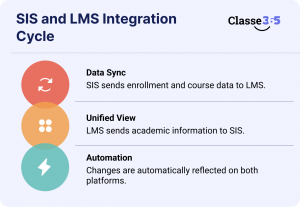
SIS and LMS systems work together to make schools run more smoothly and help students learn better:
Real-time data sync: SIS sends information about enrollments and courses to LMS as soon as it is entered.
A unified view of students: Academic information in the LMS that is sent to the SIS so that you can see everything about each student.
Automation: Changes made on one site are automatically reflected on the other, so there is no need to do it by hand.
Many modern schools use both systems to get a complete picture of how things work in the office and in the classroom. When set up correctly, data integration lets platforms talk to each other.
For instance, when a student signs up for SIS, they can automatically get access to their LMS courses. You can send LMS grades back to the SIS so they show up on report cards. Single sign-on can make it easier to log in to both platforms, which can help with login fatigue.
Integration between SIS and LMS is very important for schools that offer online learning because it makes things run more smoothly and automatically. AnyforSoft’s LMS consulting services help schools make sure that their systems can share data and work together smoothly. With the right consulting help, you can cut down on work that doesn’t need to be done, make reports more accurate, and make your business more adaptable.
SIS vs. LMS: A Quick Look at the Comparison Table
| Feature Category | SIS | LMS |
| Student Data Storage | Yes | No |
| Course & Content Delivery | No | Yes |
| Attendance Tracking | Yes | Some support* |
| Assessments & Grading | Limited | Yes |
| Fee & Financial Management | Yes | No |
| Parent / Guardian Access | Yes | No |
| Administrative Reports | Yes | Limited |
| Learning Analytics | * | Yes |
When Institutions Should Use SIS, LMS, or Both
K-12 Schools
- SIS for attendance, enrollment, and parent communication
- LMS for classroom instruction, homework, and blended learning
Higher Education & Universities
- SIS for transcripts, credits, scheduling, and student services
- LMS for academic courses, virtual classrooms, assessments
Online / Hybrid Institutions
- LMS is central for learning delivery
- SIS is essential for credentials, reporting, and operational data
As online and hybrid learning models continue to grow, institutions are increasingly investing in digital learning environments that connect administrative and instructional systems.
Main Differences: A Comparison of SIS and LMS
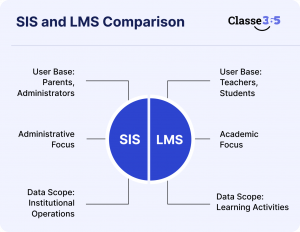
Administrative vs Academic Focus
Data integrity, compliance, and administrative workflows are the main goals of SIS platforms. LMS platforms, on the other hand, are all about delivering lessons, getting students involved, and analyzing learning.
User Base
- SIS: Parents, administrators, registrars, and leadership teams
- LMS: teachers, students, and people who design lessons
Data Scope
- SIS keeps track of data about how institutions run.
- LMS keeps track of data about learning activities.
Common Myths About SIS and LMS
Myth: LMS can replace SIS.
Truth: LMS doesn’t have the features it needs to be compliant with rules and run smoothly.
Myth: SIS is only for people who work in administration.
Truth: When used together, SIS gives teachers data that can help them tailor their lessons to each student.
Myth: Small institutions don’t need an SIS.
Truth: Automated enrollment, reporting, and data analysis are useful for schools of all sizes.
The Future of SIS and LMS with AI
As AI becomes more important in education technology, LMS platforms are adding adaptive learning, predictive analytics, and personalized pathways to close the gap between administrative data and learning outcomes.
Why Classe365’s Unified SIS and LMS Platform is the Best
Managing the whole student life cycle
Classe365 combines the most important parts of a SIS, like admissions and transcripts, with LMS features like delivering content and keeping track of assessments. This gets rid of silos.
Analytics and Reporting in Real Time
Unified dashboards let you see attendance, performance, and engagement all in one place, which helps you make decisions based on data.
Automation and Growth
Classe365 automates enrollment, grade syncing, scheduling, and compliance reporting, which is important for schools that are expanding across programs and campuses.
Ready for the cloud and safe
Cloud deployment makes sure that data is safe, that everyone can access it, and that it can be recovered in case of a disaster.
Conclusion
And this isn’t to say one is better than the other, SIS vs LMS is about what your educational institution requires. Most educational institutions need both. “Back office” functions, such as student scheduling, administrative tasks and school operations are left to the SIS, while the LMS is the engine behind learning- managing educational content, student performance and the online teaching and learning experience.
Together, they offer the prospect of transforming how your school does its work, loosening up administrators from managing student data and students/teachers to be more closely linked in working and learning.
Unsure how to use these tools, or what platform works best for your school? Contact our team of professionals at AnyforSoft to explore the possibilities and construct a solution that’s tailored just for you. Let’s make tech for smarter education—because good tech shouldn’t be overwhelming.
Keep Ahead, combine the power of SIS and LMS for a smarter more connected learning experience.
FAQ
SIS vs LMS: How do they differ?
Student info systems maintain student data, administrative management, and compliance, while LMSs concentrate on delivering learning, managing courses, and assessments.
Are SIS and LMS both necessary for the schools?
Yes, SIS manages operations and records, and LMS supports teaching and learning engagement; together, they offer a full digital experience.
Is having LMS features in an SIS possible?
Some of these SIS systems have basic learning modules, but in general, for an actual LMS, you need to provide an integrated solution.
Google Classroom: Is it an SIS or LMS?
Google Classroom, the learning management system, does not focus on student records or administration processes.
Which is better: SIS or LMS?
One does not supplant the other; institutions require both to achieve operational and academic superiority.