




An academic transcript is the official record of a student’s academic performance at a school, college, or university. It lists every course taken, the grades earned, the credits awarded, and the dates of study, certified by the institution that issued it. The meaning of an academic transcript is simple at its core: it is the formal, verifiable record of what a student studied and how they performed.
This guide covers what an academic transcript is, what goes on one, the difference between official and unofficial versions, and the situations where you will be asked to produce it.
The format is increasingly digital. The National Student Clearinghouse’s Electronic Transcript Exchange lets institutions send and receive transcripts with nearly 2,000 participating institutions and organizations, replacing the sealed paper envelope for a large share of requests.
What Does “Transcript” Mean in Education?
Outside of school, a transcript is a written copy of spoken words. The term “transcript” in education has a different meaning: it refers to the cumulative record of a student’s coursework and grades, not a recording of anything spoken.
The term gets confused with a few related documents, so it helps to separate them:
- Transcript vs report card. A report card covers one grading period. A transcript covers a student’s entire enrolment, every term, in one document.
- Transcript vs diploma. A diploma certifies that a degree was awarded. A transcript shows the full coursework and grades.
- Transcript vs degree audit. A degree audit checks progress against requirements still to be met. A transcript is the historical record of what has already been completed.
What’s on an Academic Transcript
The format varies by institution, but the core components are consistent. AACRAO, the registrars’ professional body, sets recommendations for which elements belong on the document through its official transcript practices research. A standard academic transcript includes:
| Element | What it shows |
| Student identity | Full name, student ID, date of birth |
| Institution details | School name, location, accreditation |
| Program | Major, degree sought or awarded |
| Courses | Each course taken, organized by term |
| Grades | The grade earned in every course |
| Credits | Credit hours per course and running totals |
| GPA | Term and cumulative grade point average |
| Academic standing | Honors, probation, or dismissal notations |
| Degree conferral | Degree awarded and the date, if applicable |
| Authentication | Registrar’s signature, institutional seal, issue date |
The authentication line is what makes a transcript a transcript. Without the registrar’s certification, it is just a list of grades. That certification is generated from the institution’s student information system, which holds the authoritative record every transcript is built from.
Official vs Unofficial Transcripts
The same record can be issued in two forms, and the distinction matters when an institution or employer asks for one.
| Factor | Official transcript | Unofficial transcript |
| Issued by | Registrar, sealed or certified | Self-accessed from the student portal |
| Delivered as | Sealed envelope or secure electronic exchange | Downloaded or printed by the student |
| Accepted for | Admissions, employment, licensing, immigration | Personal reference, advising |
| Tamper-evident | Yes | No |
An unofficial transcript is fine for checking your own progress. Anything with stakes attached, an application or a job offer, requires the official version sent directly from the institution, because the recipient needs proof it was not altered in transit.
What an Academic Transcript Is Used For
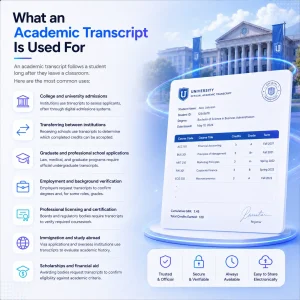
An academic transcript follows a student long after they leave a classroom. The most common uses are:
- College and university admissions. Institutions request high school or prior college transcripts to assess applicants, often through admissions and enrolment systems that receive them electronically.
- Transferring between institutions. A receiving school uses the transcript to decide which completed credits carry over.
- Graduate and professional school applications. Law, medical, and graduate programs require official undergraduate transcripts as part of the application.
- Employment and background verification. Employers request transcripts to confirm degrees and, for some roles, grades.
- Professional licensing and certification. Nursing boards, accounting boards, and similar bodies require transcripts to verify required coursework.
- Immigration and study abroad. Visa applications and overseas institutions use transcripts to evaluate academic history, often after credential evaluation.
- Scholarships and financial aid. Awarding bodies request transcripts to confirm eligibility against academic criteria.
In every case, the recipient is relying on the transcript as a trusted record, which is why how it is issued and secured matters as much as what it contains.
How Transcripts Are Issued and Stored
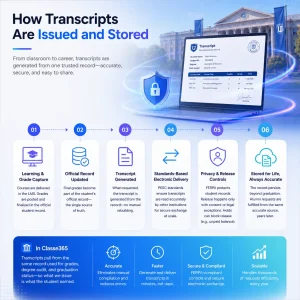
Producing a transcript used to mean a staff member compiling records by hand. Today, it is generated directly from the student record, and the difference shows in speed and accuracy.
- The grades on a transcript are derived from coursework delivered through the learning management system and are posted to the official record once finalized.
- When a transcript is requested, the institution generates it from that record rather than rebuilding it.
- When the systems are connected, the transcript reflects the most recently posted grade without manual reconciliation.
- Electronic delivery now relies on shared standards. The Postsecondary Electronic Standards Council sets the data formats that enable one institution’s transcript to be read accurately by another institution’s system, making secure electronic exchange possible at scale.
- Release is governed by privacy law. Under FERPA in the United States, a transcript is part of a student’s education record, so institutions may release it only with the student’s consent or under specific legal exceptions.
- Institutions can also place holds that block a transcript until obligations are cleared, which is why an unpaid balance tracked in fees and invoicing can stop a request from being fulfilled.
In Classe365, the transcript draws from the same record as grades, the degree audit, and graduation status, so the document a registrar issues matches what the student actually completed. Because that record persists after graduation, an alumnus requesting a transcript years later receives one generated from the same source. For universities and colleges handling thousands of requests a year, generating from one record rather than compiling by hand removes the main source of transcript error.
Why Transcript Accuracy Matters for Institutions
A transcript is only as reliable as the record behind it. When grades, transfer credits, and degree status live in separate systems, the version a registrar issues can lag behind what the student actually completed. Correcting an issued transcript after it has been sent to an employer or another institution is slow and erodes trust in the office that sent it.
Keeping the record consistent from the first point of contact in the admissions CRM through to graduation means the transcript never has to be reconciled against a second source. Every grade and credit lands in one place as it happens.
Accuracy also has a financial dimension. Transcript fees and the holds that pause a request connect to finance and accounting, so a request, an outstanding balance, and a release all reference the same student record rather than three disconnected systems that have to agree before a document can go out.
Issue and Manage Transcripts From One Record
If your registrar’s office still compiles transcripts manually, book a Classe365 walkthrough to see transcripts generated directly from the student record, ready for secure electronic delivery.
FAQ
What is an academic transcript, in simple terms?
An academic transcript is the official record of a student’s courses, grades, credits, and dates of study at an institution, certified by that institution. It is the formal proof of what someone studied and how they performed.
What is the academic transcript’s meaning versus a diploma?
A diploma certifies that a degree was awarded. The meaning of an academic transcript is broader: it shows the full coursework, grades, and credits that led to the degree, not just the final credential.
What does a transcript mean when an employer asks for one?
When an employer requests a transcript, they want the official record verifying your degree and, in some cases, your grades. It confirms the qualifications listed on a resume are accurate.
Is an unofficial transcript ever acceptable?
For personal use and advising, yes. For admissions, employment, licensing, or immigration, no. Those require an official transcript sent directly from the institution so the recipient knows it was not altered.
How do I get a copy of my academic transcript?
Request it from the institution’s registrar or through a service it authorizes, such as the National Student Clearinghouse. Most institutions offer electronic delivery; the request usually requires your consent and may incur a fee.
Can I get a transcript after I graduate?
Yes. Institutions retain academic records indefinitely, so graduates and alumni can request transcripts years later. The record is generated from the same system used while they were enrolled.
Why was my transcript request blocked?
Institutions can place holds for unpaid fees, library fines, or incomplete paperwork. The transcript is released once the hold is cleared. Contact the registrar to identify what is outstanding.
What is the meaning of “transcript” in education versus in everyday use?
In everyday use, a transcript is a written copy of speech. The meaning of the transcript in education is the cumulative academic record of a student’s coursework and grades at an institution.