




Student CRM software centralizes all inquiries, automates follow-ups, and tracks each application through a systematic workflow. It fills gaps in the guidebook that lead institutions to lose prospective students between initial contact and final enrollment. This leads to a faster, more consistent admissions process that your team can measure and improve at every step.
Why Admissions Teams Cannot Afford to Work Without One
Institutions are competing more for each enrolment. Overall, fall 2023 enrollment at postsecondary schools increased by 2.5%, although private four-year institutions have been under steady pressure and the demographic pipeline is tightening, according to the National Center for Education Statistics (NCES). For every lead your team misses, your competition gets the student.
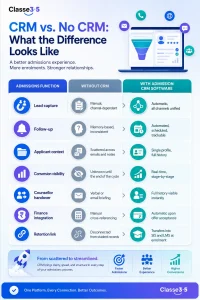
Most institutions still use shared inboxes, manual spreadsheets, and memory-based follow-ups. Admission CRM software affects that in 10 ways:
1. Captures Every Inquiry From Every Channel
Your website, a social media ad, an education fair, or a referral may lead a prospective student to you. In the absence of a central system, such questions go in separate directions and are answered differently each time.
How Classe365 Handles This
Classe365’s Pre-Admissions and Enrolment module captures leads from every channel into one unified pipeline. When a student submits an online application form, the Form Mapping feature instantly transfers their data directly into the student information system. No second step. No manual re-entry. No risk of the record being entered differently by two people.
- Web form submissions auto-create a lead record the moment a form is submitted
- Walk-in and phone inquiries are logged in the same system in real time
- Every lead gets a timestamp, a source tag, and a counselor assignment automatically
- The entire admissions pipeline is visible from one dashboard, regardless of channel
2. Assigns Leads Instantly Without Manual Distribution
A shared inbox does not scale. When 40 inquiries arrive on the same day, somebody gets missed. A lead submitted on Friday evening sits unread until Monday morning.
Admission CRM software automatically distributes leads to counselors based on rules your team establishes, such as region, course interest, language, or availability. Each counselor can only see their own pipeline. Unassigned leads trigger alerts, so nothing sits idle. If no counselor is present, leads go to the next available team member.
Research by Ruffalo Noel Levitz shows that over 80% of graduate students enroll at the institution that answers them first. The initial reaction rate is not favorable. It’s a changeover lever.
3. Automates Follow-Up at Every Stage
A student visits your open day, but doesn’t apply straight away. That encounter is gone from your pipeline in a week without a tracking system. An application is complete, except for a document that nobody has followed up on. Offer gets out, but follow-up never happens since the counselor left on leave with no handover record.
How Classe365 Handles This
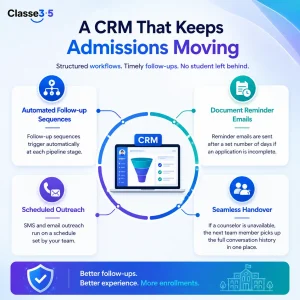
Classe365’s CRM for schools and higher education replaces memory-based follow-up with structured, automated workflows:
- Follow-up sequences trigger automatically at each pipeline stage, no manual scheduling needed.
- Document reminder emails are sent after a set number of days if an application is incomplete.
- SMS and email outreach run on a schedule set by your team, not by who remembers to send.
- If a counselor is unavailable, the next team member picks up the full conversation history in one place. No student is left waiting due to staff absence.
4. Gives Every Counselor Full Applicant Context
When a prospective student calls your admissions office, the counselor answering should already know which course they enquired about, what communications they have received, and whether their application is complete. Without a CRM, they start from scratch every time.
Admissions CRM software builds a complete profile for each applicant:
| Data Point | What It Shows |
| Inquiry source | Where the lead came from |
| Communication history | Every email, call, and message is logged |
| Application status | Which stage are they at in the pipeline |
| Documents received | What is still outstanding |
| Counsellor notes | Context from previous conversations |
| Engagement activity | Opens, clicks, form completions |
5. Personalizes Communication at Scale
Generic bulk emails do not convert. A student interested in an MBA should not receive the same message as one applying for an undergraduate science degree.
CRM software for managing student segments leads by course, geography, and academic level. Dynamic templates pull in each student’s name, course of interest, and application stage. Drip sequences adapt based on opens, clicks, and form completions. According to ICEF Monitor, students who experience a great inquiry experience accept admissions offers more than twice as often as others.
6. Tracks Conversion at Every Pipeline Stage
Most institutions cannot answer this: when do you lose the most applicants?
Assumption without data. You measure with student CRM software. Pipeline dashboards indicate how many leads are in each step in real time. Drop-off reports help you identify the least-converting subject, geography, or counselor. Time-in-stage data tells us exactly where candidates are getting stuck.
7. Reduces Counselor Workload Through Automation
Administrative tasks consume time counsellors should spend on high-intent applicants. Sending reminders, updating records, chasing documents, and generating reports: a CRM handles all of these without human input.
Status updates happen automatically when an application finishes a step. Report generation is scheduled. Counselor dashboards surface only actions requiring a human decision. When a student registers, their data is automatically fed into attendance monitoring and academic records, with no re-entry required. There are also AI-first CRM solutions that take automation a step further.
For example, platforms like HubSpot Smart CRM include specialized AI agents that autonomously handle lead generation and nurturing processes: one AI agent can interact with potential students across multiple communication channels to gather contact details and submit them to the CRM database, while the other agent uses CRM prospect data to develop personalized emails at scale to keep students engaged.
8. Supports the Role of CRM Software in Student Retention
Retention does not start at enrolment. It starts at the first interaction. A student who receives slow responses or a confusing application process is already less engaged before arriving on campus.
Students are increasingly expecting quick, tailored communication from their schools, according to EDUCAUSE’s 2025 Students and Technology Report. IIE Open Doors 2025 data indicated that new international student enrolment at U.S. colleges fell 7% in 2024-25, suggesting that institutions need to convert domestic pipelines more efficiently than ever.
The role of CRM software in student retention is to create a consistent experience from the first touchpoint. CRM engagement data transfers into the learning management system and SIS at enrolment. Counselor notes from the admissions stage are visible to academic advisors from day one.
9. Integrates With Finance to Complete the Enrolment Loop
If an offer is accepted, an applicant will still need to pay a deposit, confirm their course choice, and complete all enrolment documents. The last level is friction when finance is in a separate system. No tracking of deposits. Confirmation gets lost. The last phase is the students leaving.
How Classe365 Handles This
In Classe365, accepting an offer triggers the full financial workflow automatically:
- An invoice is generated through the fees and invoicing module the moment an offer is accepted.
- Payment confirmation automatically updates the applicant’s CRM status.
- Outstanding payment reminders are sent without counselor involvement.
- Finance and accounting reports reflect confirmed enrolment revenue in real time.
10. Generates Reporting That Drives Smarter Decisions
Each intake cycle concludes with most admissions teams compiling a report that is both time-consuming to build and out of date by the time it lands. Customer relationship management software automatically generates that data at the beginning of each cycle.
You can see how many people enrolled in each course, counselor, location, and channel in the enrollment report. You can see which outreach channels generated the highest-quality leads in your campaign reports. National Student Clearinghouse Research Center data shows that 69.5% of the 2023 class returned for their second year of college. This means that almost one-third of the class did not return. Data from pipelines and forecasts allow institutions to get in sooner. Workflows for degree audits and institutional planning are directly integrated with reporting.
How Classe365 Brings It All Together
Classe365’s admissions CRM software is part of a comprehensive platform, not a standalone tool. Your admissions pipeline, student records, LMS, fees, and alumni management all run off the same database. As a student advances from application to enrollee, their data automatically moves through the various stages, all the way through to the alumni module.
Used by 6000+ institutions in 130 countries, including the Asian Institute of Management, the U.S. Air Force, and PricewaterhouseCoopers. Prices start at $100 a month for the main module. The CRM module is $75 per month. No setup price. No credit card required to get started.
Start your 15-day free trial and run your full admissions pipeline before you commit.
FAQs
What is student CRM software?
A platform that manages every prospective student interaction from first inquiry through to enrolment, including lead capture, automated follow-ups, application tracking, and SIS integration.
How does admission CRM software improve conversion rates?
It closes drop-off gaps: slow response times, missing follow-ups, and inconsistent communication. Regardless of who responds to their inquiry, each applicant goes through the same standardized process.
What is the difference between a CRM and a Student Information System?
A CRM is used to manage prospective students before enrollment. A SIS takes care of enrolled students: attendance, grades, fees, and academic records. Both should be integrated so that data is automatically transferred at the point of enrolment.
What is the role of CRM software in student retention?
It starts prior to enrolling. A student’s experience of the admissions process influences their participation from day one. Once enrolled, CRM data and counselor notes are added to student support workflows, providing academic advisers with instant insight.
Can small institutions benefit from admissions CRM software?
Yes. Modular pricing means small schools pay only for what they use. Automated follow-up and centralized lead tracking reduce lost applicants even at low inquiry volumes.
How does CRM software for managing students handle multiple campuses?
Leads and pipelines segment by campus, course, or geography. Counselors see only their assigned leads. Administrators see the full institutional view across all campuses.
Does CRM software integrate with existing tools like LMS and SIS?
Yes, if you choose a platform with native integrations. Third-party API connections between separate tools can break on updates. A unified platform where CRM, SIS, and LMS share one database removes that risk.
How do I measure whether my CRM is improving admissions?
Track four metrics: inquiry-to-application rate, application-to-offer rate, offer-to-enrolment rate, and time-to-enrolment. A functioning CRM gives you these in real time, without manual reporting.