



FERPA compliance software helps schools manage access to education records, control user permissions, document disclosures, and support student data privacy processes. The software can provide the controls schools need to manage FERPA requirements, but using a platform alone does not make an institution compliant.
Schools evaluating these controls can also review the Classe365 Student Information System to see how one platform can manage student records and academic workflows.
Schools subject to FERPA must protect education records and follow rules governing access and disclosure. The U.S. Department of Education provides guidance on these rights and obligations.
This guide explains what FERPA compliance is, the FERPA compliance requirements schools should consider, what to look for in FERPA compliance software, and how to create a practical FERPA compliance checklist.
What Is FERPA Compliance?
What is FERPA compliance? It means protecting student education records and personally identifiable information according to FERPA. Schools must control access to records and follow applicable rules for consent, disclosures, and recordkeeping.
The FERPA compliance requirements cover how schools give staff access to education records, disclose information, and manage third-party access. FERPA compliance software can support these processes with role-based permissions, access controls, audit trails, and disclosure tracking.
A Student Information System can centralize student records while giving administrators control over user access. Schools must still configure these controls correctly and follow their own FERPA requirements.
What Are the FERPA Compliance Requirements for Schools?
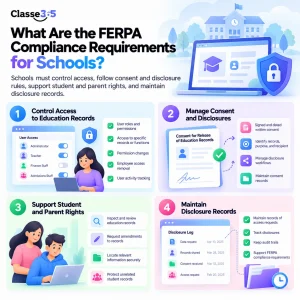
Schools must control access to education records, follow consent and disclosure rules, support student and parent rights, and maintain required disclosure records. These are the core FERPA compliance requirements to address when evaluating FERPA compliance software.
Control Access to Education Records
Staff should access only the education records they need for a legitimate educational interest.
FERPA compliance software should provide controls for:
- User roles and permissions
- Access to specific records or functions
- Permission changes
- Employee access removal
- User activity tracking
Schools can also review their Classe365 Learning Management System when assessing how access controls apply across academic and learning workflows.
Manage Consent and Disclosures
FERPA generally requires signed and dated written consent before a school discloses personally identifiable information from an education record, unless an applicable exception applies. The consent should identify the records, purpose, and recipient.
FERPA compliance software can help staff record consent information and manage disclosure workflows. This gives administrators a consistent way to apply their FERPA requirements when handling student-data requests.
Support Student and Parent Rights
Parents and eligible students have the right to inspect and review education records and request amendments to records they believe are inaccurate or misleading.
Schools should be able to locate relevant information without exposing unrelated student records. Where student information connects with enrolment workflows, the Classe365 admissions and enrolment management tools can provide a relevant workflow reference.
Maintain Disclosure Records
Schools generally need to maintain records of requests for access to and disclosures of personally identifiable information from education records, subject to applicable exceptions.
Audit trails and disclosure tracking in FERPA compliance software can help administrators maintain these records and support their FERPA compliance requirements.
What Should FERPA Compliance Software Include?
The right FERPA compliance software should provide practical controls for managing education records, user access, disclosures, and third-party access.
| Feature | What schools should check |
| Role-based access | Can permissions match each user’s responsibilities? |
| Permission controls | Can administrators restrict records and system functions? |
| Audit trails | Can authorized users review relevant activity and changes? |
| Consent management | Can applicable consent information be recorded? |
| Disclosure records | Can required disclosure information be maintained? |
| User management | Can access be changed or removed quickly? |
| Data export | Can authorized staff retrieve records when required? |
| Vendor controls | Does the provider explain how it handles education records? |
| Data retention | Are retention, return, and deletion practices documented? |
The platform should also fit into the school’s wider technology environment. A student information system may manage enrollment, academic records, attendance, grades, and other sensitive information in one environment.
For schools reviewing the wider platform, the Classe365 school management software page explains how its SIS, LMS, CRM, finance, and other modules work together.
How Should Schools Evaluate FERPA-Compliant Student Information Systems?
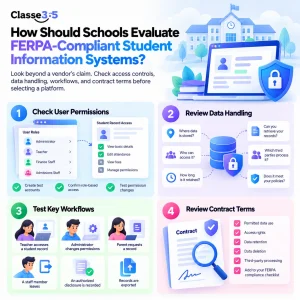
Look beyond a vendor’s FERPA-compliant student information systems claim. Check access controls, data handling, workflows, and contract terms before selecting a platform.
Check User Permissions
Create test accounts for different staff roles. Confirm that each user can access only the records and functions required for their work. Test permission changes when employees change roles or leave.
The U.S. Department of Education’s Student Privacy Policy Office is reviewing 1,504 local education agencies over four years to assess how they communicate student privacy information, with 376 LEA websites reviewed each year.
Review Data Handling
Ask where student data is stored, who can access it, how long it is retained, whether the school can retrieve its records, and which third parties process it. Compare the answers with school policies and contract requirements.
Test Key Workflows
Test practical scenarios before deployment:
- A teacher accesses a student record
- An administrator changes permissions
- A parent requests a record
- A staff member leaves
- An authorised disclosure is recorded
- Records are exported
These tests show whether the platform supports the school’s FERPA compliance requirements in practice.
Review Contract Terms
Check permitted data use, access rights, retention, deletion, and third-party processing. Add these points to the FERPA compliance checklist before signing the agreement.
What Do FERPA Regulations for Schools Require From Third-Party Providers?
FERPA regulations for schools allow certain third-party providers to access education records without separate consent when they meet the school official exception. The provider must perform an institutional service, remain under the school’s direct control, and follow FERPA limits on using and redisclosing education records.
Before giving a provider access to student data, schools should check:
- Service: Does the provider perform a service the school would otherwise perform itself?
- Access: Can the school control which records the provider can access?
- Data use: Does the contract limit use of education records to authorized purposes?
- Redisclosure: Does the provider follow applicable restrictions on redisclosing records?
- Subprocessors: Does the school know which third parties may process the data?
- Retention: Does the contract define data retention and deletion?
- Return: Can the school retrieve its records when the agreement ends?
These checks help schools apply their FERPA requirements when assessing ferpa compliance software and other providers that handle education records.
What Data Privacy Controls Should Schools Check?
Schools should check whether data privacy education software protects student information through encryption, authentication, access controls, audit logs, backups, and data retention controls.
Check These Privacy Controls
The platform should provide:
- Encryption in transit and at rest
- Role-based access
- Strong authentication
- Audit logging
- Backup and recovery
- Data retention controls
- Subprocessor oversight
- Data export and deletion
The 2025 CIS MS-ISAC K–12 Cybersecurity Report analyzed more than 5,000 K–12 organizations between July 2023 and December 2024. It found that 82% of reporting K–12 schools experienced cyber-threat impacts, with nearly 14,000 security events and 9,300 confirmed cybersecurity incidents.
These figures make security controls an important consideration when selecting data privacy education software. Schools should also check whether those controls support their FERPA compliance requirements when the platform stores or processes education records.
How Can Schools Build a FERPA Compliance Checklist?
A FERPA compliance checklist should cover access, consent, disclosures, vendor controls, security, and data retention. Use it to evaluate education compliance software before deployment.
| Area | What to check |
| Access | Can the school restrict records by user role? |
| Permissions | Can administrators change or remove access? |
| Consent | Can applicable consent information be recorded? |
| Disclosures | Can required disclosure records be maintained? |
| Vendor access | Does the provider define who can access education records? |
| Data use | Are permitted uses clearly documented? |
| Retention | Are retention and deletion rules defined? |
| Security | Are authentication, encryption, backup, and recovery controls documented? |
| Subprocessors | Does the vendor identify relevant third parties? |
| Export | Can authorised users retrieve records when needed? |
| Testing | Have key workflows been tested before deployment? |
For schools connecting compliance checks with administrative workflows, Classe365 Finance & Accounting is another platform area to review when assessing how financial and student data are handled.
The FERPA compliance checklist should also match the school’s privacy policies and vendor agreement. A compliance claim alone does not establish that software meets the school’s FERPA requirements.
How Does Classe365 Support FERPA Compliance?
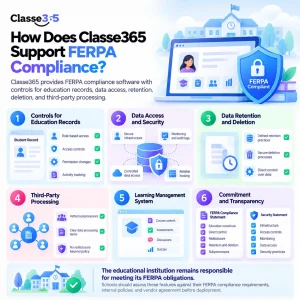
Classe365 supports schools with FERPA compliance software through controls for education records, data access, retention, deletion, and third-party processing. Its FERPA Compliance Statement outlines the platform’s commitments around education-record use, direct control, redisclosure, retention, deletion, subprocessors, and security. It also states that the educational institution remains responsible for meeting its FERPA obligations.
The platform also provides a learning management system for course content, assessments, discussions, and quizzes. It also provides a Security Statement covering its infrastructure, access controls, monitoring, data access, hosting, and security practices.
Schools should assess these features against their FERPA compliance requirements, internal policies, and vendor agreement before deployment.
Ready to Review Your FERPA Compliance Requirements?
If you are evaluating FERPA compliance software for your school, book a Classe365 implementation walkthrough to discuss your student-record, access-control, data-management, and workflow requirements.
You can also review Classe365 pricing when comparing platform requirements and available modules.
FAQ
What is FERPA compliance?
What is FERPA compliance? It means following the Family Educational Rights and Privacy Act when a covered educational institution handles education records and personally identifiable information. The school remains responsible for establishing appropriate policies and practices.
What are the main FERPA requirements for schools?
The main FERPA requirements cover access to education records, consent and disclosure rules, parent and eligible student rights, and required disclosure records. Specific exceptions apply to some disclosure situations.
Does FERPA require schools to use FERPA compliance software?
No. FERPA does not require schools to use a specific technology platform. FERPA compliance software can support the controls and workflows a school uses to meet its FERPA obligations.
Are FERPA-compliant student information systems automatically compliant?
No. FERPA-compliant student information systems can provide controls that support compliance, but the school’s configuration, policies, staff practices, contracts, and vendor oversight also affect how the institution meets its FERPA requirements.
Does FERPA require written consent for every disclosure?
No. FERPA contains specific exceptions to its general written-consent requirement. When consent is required, it must identify the records, purpose, and recipient.
Can software vendors access student records under FERPA?
Yes, in certain circumstances. A third-party provider may qualify under the school official exception when it meets the applicable conditions, including performing an institutional service and remaining under the school’s direct control regarding the use and maintenance of education records.
What should schools include in a FERPA compliance checklist?
A FERPA compliance checklist should cover user permissions, access controls, consent, disclosure records, audit trails, vendor access, data use, retention, deletion, exports, subprocessors, and security controls.
Is data privacy education software the same as FERPA compliance software?
No. Data privacy education software focuses on protecting student information through technical and operational controls. FERPA compliance software supports the processes and controls a school uses to manage its FERPA obligations. The two areas overlap but are not identical.