



A degree audit is a report that compares a student’s completed and in-progress coursework against the requirements for their degree, then shows exactly what is left to graduate. It answers one question in a single view: Am I on track? For students, it removes guesswork; for universities, it replaces hours of manual checking with an up-to-date record.
This guide explains what a degree audit is, what a degree audit report contains, how to read one, and why it matters on both sides of the registrar’s desk.
Did you know? A bachelor’s degree typically requires 120 credits, but students at non-flagship public universities graduate with an average of 136.2 credits, well above the degree requirement (EdInsights Center). Those extra 16 credits are roughly a full semester’s worth of tuition that an accurate degree audit is designed to prevent.
What Is a Degree Audit?
A degree audit maps every requirement in a student’s program and checks their academic record against it. Core courses, major requirements, electives, credit totals, GPA minimums, and residency rules all sit in one place, each marked as met, in progress, or outstanding.
It is generated from the student’s official record, which lives in the student information system. Because the audit is based on that record, it reflects the institution’s actual requirements rather than a student’s own interpretation of the catalog. That distinction matters: most credit waste comes from students taking courses that do not count toward their degree, and a degree audit surfaces those gaps before they cost a semester.
A degree audit is also part of a student’s education record, which means that access to and disclosure of it fall under FERPA in the United States. Institutions treat it as protected data, not a casual report.
What a Degree Audit Report Contains
A degree audit report breaks a program down into its parts and shows progress against each one. A complete report typically includes:
- Completion status, often as a percentage of requirements met
- Requirement categories, such as core, major, minor, and electives, are each marked met, in progress, or unmet
- Courses applied to each requirement, including the grade earned
- Remaining requirements and the exact credits still needed
- GPA and academic standing against the program’s minimum requirements
- Transfer, AP, and exam credits, and where they have been applied
- Excess or unapplied credits that do not count toward the degree
- What-if scenarios that model how a major or minor change would affect remaining requirements
The last two are where a degree audit report is most valuable. Excess credits show a student exactly where effort is going to waste, and what-if modeling lets them test a change of direction before committing to it.
What Does a Degree Audit Example Look Like?
A degree audit example makes the report concrete: it lists each requirement, the credits needed, the credits earned, and what remains, with a status for each. The table below shows a simplified audit for a student partway through a 120-credit bachelor’s degree.
| Requirement | Credits required | Credits earned | Remaining | Status |
| General education (core) | 42 | 42 | 0 | Complete |
| Major requirements | 48 | 36 | 12 | In progress |
| Electives | 30 | 24 | 6 | In progress |
| Total credits | 120 | 102 | 18 | On track |
| Minimum GPA (2.0 required) | 2.0 | 3.2 | — | Met |
| Residency (30 credits on campus) | 30 | 30 | 0 | Met |
Read across, the example gives the student everything in one view: general education and residency are done, the GPA clears the minimum, and 18 credits remain, 12 in the major and 6 in electives. At 102 of 120 credits, the student is 85% complete and on track, with a clear list of what to register for next. A real audit would name the specific outstanding courses under each category, but the structure is the same.
How to Read Your Degree Audit Report
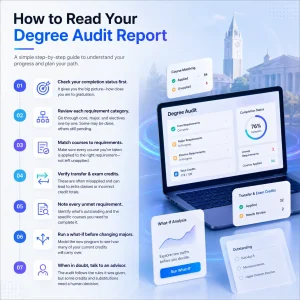
Students often see a degree audit report for the first time and don’t know where to look. These steps cover what to check, in order:
- Start with the completion status. It tells you how close you are overall before you read the details.
- Work through each requirement category. Confirm core, major, and elective sections individually, since one can be complete while another lags.
- Match courses to requirements. Check that each course you have taken is applied to a requirement, not sitting unapplied.
- Verify transfer and exam credits. Misapplied transfer credit is a common error and a frequent cause of excess enrolment.
- Note every unmet requirement. List what is outstanding and the specific courses that satisfy it.
- Run a what-if before changing majors. Model the new program first to see how many existing credits carry over.
Anything that appears to be miscounted goes to an academic advisor. The audit is accurate to the rules it was given, but transfer equivalencies and substitutions sometimes need a human decision.
Why Degree Audits Matter
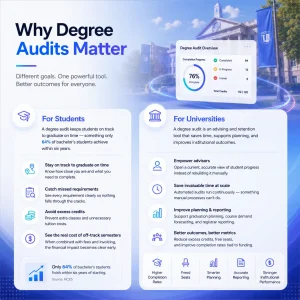
The value of a degree audit splits cleanly between the two groups who use it.
For Students
A degree audit keeps students on track to graduate on time, which is less common than most assume. NCES reports that only 64% of bachelor’s students finish within six years of starting (NCES), and the four-year rate is considerably lower. A clear audit shows students what stands between them and graduation, flags requirements they might otherwise miss, and prevents the excess credits that turn into extra tuition. Run alongside fees and invoicing, it also makes the financial cost of an off-track semester visible early.
For Universities
For institutions, the degree audit is an advising and retention tool. Advisors who would otherwise rebuild a student’s progress by hand for every appointment instead open a current view. That time-saving scales: a single advisor managing hundreds of students cannot manually re-audit each one every term, but an automated system does it continuously. Accurate audits also support graduation planning, course demand forecasting, and the degree audit reporting that registrars rely on to confirm who is eligible to graduate. Reducing excess credits has an institutional payoff too, since it frees seats and improves completion metrics tied to funding.
What Causes Excess Credits
Excess credits rarely come from students deliberately overreaching. Research cataloging why they accumulate points to a consistent set of causes: changing majors after completing courses that no longer count, transfer credits that fail to map onto the new program, and advising gaps that let students enroll in classes outside their requirements (ERIC research database).
A degree audit addresses each one directly. It shows which completed courses no longer apply after a major change, flags transfer credits that were never mapped to a requirement, and gives advisors a current view so that off-track enrolment is caught in week one rather than at the graduation check. The audit does not stop a student from changing direction. It makes the cost of that change visible while there is still time to plan around it.
Manual vs Automated Degree Audits
How a degree audit is produced determines how useful it is. The difference between a manual process and an automated one is stark.
| Factor | Manual degree audit | Automated degree audit |
| Who produces it | Advisor or registrar, by hand | Generated by the SIS |
| Time per student | Hours | Real-time |
| Error risk | High, from manual rechecks | Low, rules applied consistently |
| Student access | On request only | Self-service, anytime |
| Updates | Redone each time | Live as grades post |
A manual audit is a snapshot that is out of date the moment a grade changes. An automated degree audit reads the live student record, so the report a student sees in the morning reflects the grade posted overnight. In Classe365, the degree audit module runs inside the same system as admissions, records, and finance, so requirement tracking, transfer credits, and graduation eligibility draw from one source rather than a synced copy. For universities and colleges, this removes the gap between what the advisor sees and what the record actually holds.
Where a Degree Audit Fits in the Student Lifecycle
A degree audit does not work in isolation. It reads grades from courses delivered through the learning management system, builds on the student record that begins when a prospect is recruited through the admissions CRM, and marks the point at which a student moves from enrolled to graduating and into the alumni stage. When these run on one platform, the audit reflects every grade and credit the moment it is recorded, with no lag between systems and no risk of one record contradicting another.
See a Degree Audit in Action
If your advising team still rebuilds student progress by hand, book a Classe365 degree audit walkthrough to see automated, live tracking against real program requirements.
FAQ
What is a degree audit, in simple terms?
A degree audit is a report that compares a student’s completed and in-progress courses against their degree requirements and shows what remains to graduate. It marks each requirement as met, in progress, or outstanding.
What is the difference between a degree audit and a transcript?
A transcript lists every course and grade a student has earned. A degree audit organizes the record against a specific program’s requirements and shows progress toward the degree. The transcript is history; the audit is a plan.
How often should a student check their degree audit report?
At least once a term, and before registering for the next one. Checking the degree audit report before course selection prevents enrolling in classes that do not count toward the degree.
Can a degree audit be wrong?
It can be inaccurate if transfer credits, substitutions, or exceptions were not entered correctly. The audit applies the rules it is given, so a student who spots a miscount should raise it with an advisor rather than assume it is final.
What is a “what-if” degree audit?
A what-if audit models a student’s progress against a different program. It shows how many existing credits would carry over if they changed major or added a minor, which helps students decide before committing.
Who can see a student’s degree audit?
The student, their assigned advisors, and authorized staff. Because it is part of the education record, access is governed by privacy rules such as FERPA, and institutions limit who can view it.
Do degree audits help reduce time to graduation?
Yes. By making outstanding requirements and unapplied credits visible, a degree audit helps students avoid unnecessary courses and the extra semesters that excess credits cause.
How does an automated degree audit differ from a manual one?
An automated degree audit is generated by the student information system in real time and updates as grades are posted. A manual one is built by staff on request and is out of date as soon as the record changes.