




An University ERP system centralizes the management of the admissions process, academic records, financial records, human resources, and reporting from one integrated platform, which can improve campus operations while also lowering costs. In summary, ERP software solutions for universities replace disparate tools and manual processes with automated, routine processes which can free up administrative staff and provide a centralized real-time view of all departments in the university.
In this article, we outline the effect that broken systems have on operational expenses for higher education; review how automating the university workflow can streamline the admissions, fee collection and academic processes; review the effect that integrated data has on the collaboration of academic and administrative teams; identify the ways in which colleges and universities see quantifiable ROI after implementing their ERP systems (e.g., decreased manual effort, quicker approvals, better cash flow, and a decreased reliance on additional administrative staff); and provide some ideas on what colleges and universities should consider when evaluating which scalable campus operation management system can help achieve long-term growth.
What Is a University ERP?
An University ERP (Enterprise Resource Planning) solution is an integrated solution used to manage the processes associated with managing the admissions process, and the academic record-keeping of the students as well as their financial records, as well as other student-related data, as well as facilitate communication with students, faculty, staff, and alumni.
Rather than using many different tools, Colleges and Universities will typically implement an ERP solution, enabling them to automate the workflows associated with managing each of these types of information. When a student applies and subsequently registers at an institution of higher learning, data entered into the admissions application will automatically transfer to other departments, thus removing the need to re-enter the same data into multiple systems, as well as minimizing the likelihood of data entry errors.
Institutions can replace separate SIS, LMS, CRM, and finance tools with one unified platform improving coordination and scalability. This is where ERP ROI in higher education becomes clear, lower operational costs, improved efficiency, and better campus-wide collaboration.
Where Universities Lose Money Without ERP
Hidden operational inefficiencies significantly impact institutional budgets. Without ERP, universities commonly experience:
| Cost Leakage Area | Operational Impact | Financial Impact |
| Manual admissions | Increased staff workload | Higher administrative cost |
| Delayed fee tracking | Payment follow-ups | Revenue delays |
| Duplicate data entry | Errors and rework | Productivity loss |
| Disconnected systems | Data reconciliation | IT maintenance cost |
| Underutilized resources | Inefficient scheduling | Infrastructure waste |
These cost leakages accumulate over time and reduce overall operational efficiency.
How University ERP Improves Campus Operations
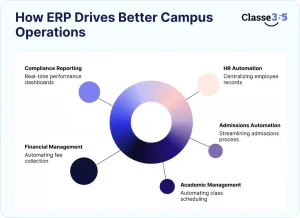
A university ERP system improves campus operations by connecting academic, administrative, and financial workflows into one platform. Instead of relying on spreadsheets and disconnected tools, institutions can automate routine processes, improve coordination across departments, and reduce operational delays.
Admissions & Enrollment Automation
University ERP systems assist with streamlining the admissions process by providing functionalities for automating the collection of required documentation for the admissions process, automating the status of an applicant to eliminate manual review and improving the timeliness of the admissions cycle in the peak months of entry.
Academic & Timetable Management
University ERP systems provide functionalities for automating the scheduling process for classes, faculty workloads, and course offerings. With ERP systems, departments can coordinate their schedule in real-time, eliminating scheduling conflicts and reliance on spreadsheets.
Financial & Fee Management Systems
University ERP systems help to streamline the financial operations of an institution through the automation of fee assessments, invoice generation/processing, payment gateway integration and fee collection. Sponsored by the ERP system, institutions can automate reminders for fees owing, facilitate tracking of fees due and significantly reduce the amount of time required to reconcile fee collections, providing greater visibility into cash flow.
HR & Payroll Automation
Universities utilize university ERP systems for centralizing faculty/staff records, automating payroll processing and leave tracking. The use of university ERP systems reduces the amount of manual processing required from an HR standpoint while improving operational accuracy.
Compliance & Reporting Capabilities
With ERP systems, real-time dashboards provide university leadership with how their institution is performing in the areas of admissions, academics, and financial management. This ultimately enables universities to make better decisions related to institutional planning, compliance reporting and being prepared for the accreditation process.
How University ERP Reduces Operational Costs
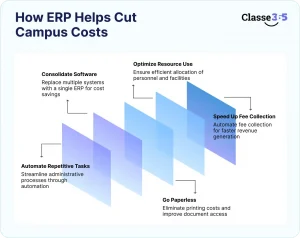
ERP software for colleges reduce their operational costs in many ways, but the most significant cost reductions arise from the elimination of redundant systems and automation of repetitive processes
Less Work for the Administration
Because of the automation of repetitive tasks (such as approvals and data entry) associated with things like finance, enrollment management, and academic performance, school leadership teams can spend less time doing operational work and instead focus on strategic work.
Software Consolidation Savings
When a university replaces multiple student information systems, learning management systems, finance, and CRM software applications with a single ERP application, it creates cost savings from lower license fees, integrated maintenance, and reduced integration between the systems.
Paperless Operations
The move to paperless operations through digital document management and workflows enables schools to eliminate the cost of printing documents and their associated printing supplies and space. Schools also benefit from faster access to documents and readiness for an audit.
Improved Use of Resources
Because the scheduling and management of all personnel, classrooms, and resources at an institution are optimized, there is little if any under-utilization of resources that produces waste.
Faster Fee Collection
ERP systems enable institutions to automate the collection of fees by sending payment reminders and using integrated processing gateways to speed up the collection of outstanding fees.
Cost Comparisons: ERP vs. Multiple Campuses
Most institutions have multiple applications to manage their admissions, academics, finances, and reporting. This probably worked when the institution was first established, however, many of them have very similar functionality, creating challenges for integrating and maintaining multiple systems as well as limiting the ability to scale. An ERP system consolidates all of these applications into a single application, resulting in increased efficiency, decreased complexity, and improved operational performance.
| Factor | University ERP | Multiple Systems |
| Data Management | Centralized | Siloed |
| Operational Cost | Lower | Higher |
| Reporting | Real-time | Manual |
| Maintenance | Single vendor | Multiple vendors |
| Scalability | High | Limited |
Universities using multiple tools typically face data inconsistencies, higher integration costs, and slower decision-making. A unified ERP reduces these inefficiencies and supports scalable campus operations.
University ERP ROI Timeline (0-12 Months)
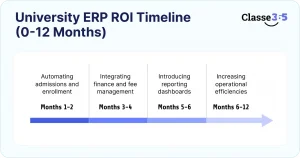
ROI from an ERP in Higher Education is mostly seen in phases as different departments transition from their manual operations to automation of their processes. Most universities see operational changes in their department operations within the first year of implementation.
- Months 1-2: Automating the admissions and enrollment process will reduce manual data entry and accelerate the approval of applicants.
- Months 3-4: Integrating finance and fee management will provide better tracking and reconciliation of fees.
- Months 5-6: With the introduction of reporting dashboards, academic and financial performance data can be collected in real-time.
- Months 6-12: There will be an increase in operational efficiencies from reduced administrative workloads and measurable cost savings.
With continued adoption of a unified department-wide workflow, value from your university ERP solution will continue to grow; providing improved operational efficiencies, collaboration between departments, and allowing your organization to scale for future growth.
When Should Universities Consider Using an ERP?
As a university experiences growth and there is increased departmental operating complexity (especially in areas of admissions, financial, and administrative), it is necessary for the institution to implement an ERP solution. As an institution continues to grow, their inability to coordinate activities using too many disconnected tools and manual processes creates delays, duplicate data entry, and inconsistent reporting, all of which necessitate a central system.
In general, an ERP solution becomes critical to an institution when one of the following ‘operational thresholds’ has been reached.
- Coordination challenges require cooperation between admissions, academic, and finance; all of which utilize their own distinct systems.
- The student population exceeds 800–1,500 students, therefore creating additional administrative workload/activity disorganization, and more complex data management.
- The institution tracks the admissions process, reconciles fees, and schedules class timetables through the use of spreadsheets.
- Increased staffing levels are needed to coordinate repetitive operational activities, which requires multiple independent applications to support student information (SIS), learning management (LMS), customer relationship management (CRM), and finance systems, creating integration obstacles.
Institutions experienced limited real-time reporting capabilities; therefore, their academic and financial decision making was delayed. Institutions can see these signals manifest themselves, as centralized data and automated workflows result in lower operational delays, increased visibility, and reduced administrative costs, these institutions will experience the highest degree of ERP return on investment in higher education.
Key Capabilities to Look for in a Cost-Saving University ERP
Not all university ERPs provide cost-effective solutions. Universities evaluating an ERP for improving campus operations management must assess an ERP’s functionality to provide cost-effective operations management through improving administrators’ efficiency, identifying financial visibility, as well as increasing coordination across multiple departments.
Cost Saving ERP Software For Universities Should Include:
- Automated Admissions and Enrollment Processes: Reduce manual processing of applications and eliminate duplication of data by automating application processes (i.e., eligibility verification)
- Integrated Finance and Fee Management: Real-time tracking of fees, invoices, and reconciliation; automated processes for accounting entry; centralization of financial records across departments.
- Automated Course Scheduling and Academic Process: Automate the scheduling of classes and determine the utilization of faculty’s time and space within a classroom through scheduling automation.
- Centralized Student Life Cycle Management System: Consolidate student inquiries through alumni engagement to centralize student life cycle management under one system.
- Real-Time Data and Analytic Dashboards: Provide real-time data and reporting for admissions, academic performance, and revenue to optimize access to accurate and timely information.
- Role-Based Access Control (RBAC): Provide role-based access controls across departments to secure data.
- Cloud-Based Deployment: Minimize total cost of ownership (TCO) through reduced infrastructure, facilities, operating system and maintenance costs.
By establishing a platform that combines multiple functions, these settings are able to establish a unified tool for institutions that eliminates numerous stand-alone systems, enhances the efficiency and effectiveness of campus operations and maximizes the return-on-investment of ERPs in higher education (e.g., Classe365).
Enhance Campus Effectiveness with an Integrated ERP
Colleges interested in enhancing their campus operation and managing the increasing costs they are incurring need not only numerous independent applications at different levels of the schools, but they also need a college ERP that integrates the functions of Admissions, Academics, Finances as well as reporting functions on one platform, so that data flows smoothly between departments.
The college ERP solution helps institutions reduce labor-intensive activity, improves resource utilization, and provides real-time decision making capability therefore enabling colleges to lower administrative costs and operate more effectively at scale. When implemented in higher education institutions the long-term effect of a college ERP will be to enhance collaboration between departments, allow for greater financial visibility and return on investments (ROI) thus, making it a valued investment in institutions that want to grow in a sustainable manner.
FAQ
1. What operational costs can a university ERP system reduce first?
A university ERP system typically reduces administrative costs first by automating admissions processing, fee tracking, and reporting. These areas involve repetitive manual work, which increases staff workload and operational overhead. By centralizing workflows, institutions often see early savings in administrative hours, reduced data errors, and faster fee reconciliation.
2. How does a university ERP improve inter-department collaboration?
ERP software for universities connects admissions, academics, finance, and HR on a shared database. When student data is updated in one department, it becomes instantly available across others. This eliminates email-based coordination, reduces duplicate data entry, and improves operational alignment.
3. Can a university ERP reduce the need for additional administrative staff?
Yes. By automating approvals, data entry, and reporting, a university ERP system reduces repetitive operational tasks. Institutions can manage growing student numbers without proportionally increasing administrative headcount, improving operational efficiency and cost control.
4. How long does it take to see ROI from a university ERP implementation?
Most institutions begin to see ERP ROI in higher education within 3–6 months through faster admissions workflows and improved fee tracking. Full operational cost savings typically become visible within 6-12 months as departments adopt unified workflows.
5. What is the difference between university ERP and multiple campus software tools?
Multiple campus tools operate in silos, requiring integrations and manual reconciliation. A university ERP system centralizes admissions, academics, finance, and reporting, reducing integration costs, improving data accuracy, and providing real-time dashboards.
6. How does ERP software improve fee collection efficiency?
ERP software for universities automates invoicing, payment reminders, and reconciliation. Integrated payment gateways allow institutions to track dues in real time, improving cash flow and reducing delays in fee collection.
7. Is university ERP suitable for mid-sized institutions?
Yes. Institutions managing 800-1500 students often benefit from ERP adoption as operational complexity increases. A centralized platform helps reduce spreadsheet dependency and improves reporting visibility.
8. What features should universities prioritize for cost savings?
Universities should prioritize workflow automation, integrated finance management, centralized student lifecycle tracking, real-time analytics dashboards, and cloud deployment. These features directly impact operational efficiency and administrative costs.