




GPA calculation software automatically computes a student’s grade point average from their grades, credits, and grading scale, rather than relying on manual formulas. The result is fewer errors, because the same rules apply to every student every time. This guide explains what GPA is, how it is calculated by hand, where the manual process breaks down, and how software addresses the accuracy problem.
Grading is already a heavy administrative load. Across OECD education systems, about half of teachers report excessive administrative work as a source of work-related stress, according to the 2025 TALIS study. GPA calculation is part of that load, and it is one of the easiest parts to get wrong.
Why One Student Can Have Several Different GPAs
Most people assume a student has a single GPA. In practice, they often have several, all calculated correctly, because the GPA meaning depends entirely on which rules an institution applies. The same transcript can produce different numbers depending on what gets counted.
GPA stands for Grade Point Average, the credit-weighted average of a student’s grades, and a GPA score on the common US scale runs from 0.0 to 4.0. But that single definition hides several choices. A weighted GPA adds extra points for Honors or AP courses, so it can exceed 4.0, while an unweighted one caps at 4.0. A core GPA counts only academic subjects for class rank and ignores electives. A major GPA counts only courses in the student’s field. Each is a legitimate answer to “what is GPA mean” for a different purpose.
This is exactly why accuracy is hard. When someone asks what GPA is for a given student, the honest reply is “which one?” An admissions office, a scholarship body, and a sports eligibility office may each require a different calculation based on the same grades. Producing all of them by hand, consistently, is where manual methods fall apart, and it is the first reason institutions move to software that can apply each rule set without re-keying a thing.
How GPA Is Calculated
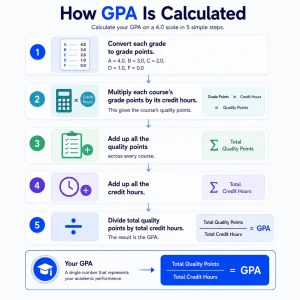
Knowing how to calculate GPA comes down to five steps. Here is how to calculate GPA from grades on a 4.0 scale.
- Convert each grade to grade points. A = 4.0, B = 3.0, C = 2.0, and so on.
- Multiply each course’s grade points by its credit hours. This gives the course’s quality points.
- Add up all the quality points across every course.
- Add up all the credit hours.
- Divide total quality points by total credit hours. The result is the GPA.
A worked example makes it concrete. A student takes Biology (4 credits, grade A), History (3 credits, grade B), and Math (3 credits, grade C). Their quality points are 16 (4 × 4.0), 9 (3 × 3.0), and 6 (3 × 2.0), totaling 31. Total credits are 10. So the GPA is 31 ÷ 10 = 3.1. That is how to calculate your GPA for a single term.
How to Calculate Overall GPA Across Terms
A single term is straightforward. Knowing how to calculate overall GPA across several terms is where it gets harder, because you cannot simply average the term GPAs. The overall GPA, often called the cumulative GPA, weights each course across all terms by its credits.
To do it correctly, you add the quality points from all terms and the credit hours from all terms, then divide one by the other. A student cannot just average a 3.1 from one term and a 3.5 from another, because the terms may carry different credit loads. This is the first place a manual GPA system starts to produce wrong numbers.
Where Manual GPA Calculation Goes Wrong
Manual GPA calculation fails in predictable ways, and every failure traces back to a human applying a rule by hand. Research on educational data finds that data-entry errors are the primary source of inaccuracy in academic records, because the figures are keyed and computed by people rather than measured.
The common errors are specific:
- Scale confusion. Converting a 4.0 GPA to a 10.0 scale by doubling is wrong, because scales are not linearly comparable.
- Weighting mistakes. Forgetting to weight by credit hours treats a 1-credit elective the same as a 4-credit core course.
- Pass/Fail miscounting. Including a Pass/Fail grade in the average when it should be excluded.
- Rounding inconsistency. Different people round at different points, producing different results from the same grades.
- Transfer credits. Mapping credits from another institution incorrectly, or counting them when they should not be.
What GPA Calculation Software Does
GPA calculation software removes the human step that causes those errors. It applies one configured grading scale to every student, weights by credit hours automatically, and recalculates the moment a grade changes. Because the rules live in the system rather than in someone’s head, a Pass/Fail grade is handled the same way every time, and rounding is consistent across the whole institution.
The deeper benefit is that the GPA system reads from the grades already on record. There is no re-entry into a separate calculator, which is where transcription errors creep in. Those grades typically originate in coursework run through the learning management system and post straight through, so the software performs the same steps to calculate GPA from grades without the manual slips. The GPA meaning never changes between the two methods; only the reliability does. Automating this kind of administrative work also returns real-time data, with Gallup finding that teachers who use digital tools weekly save close to six hours a week.
How GPA Calculation Software Works in Classe365
Classe365 calculates GPA within its Assessment & Grading Module, automatically applying the credit-weighted method. Setup follows a clear sequence:
- Set subject credits or hours for each subject to define its weight in the GPA.
- Build a grading scale and enable grade points, mapping each score band to a grade point value.
- Enable GPA in the score table settings, then select the grade-point-enabled scale.
- View the report card, where GPA computes automatically as total credit points divided by total credit hours, with each subject’s credit points equal to its GPA score multiplied by its credits.
- Pass/Fail and non-numerical overrides are excluded automatically, so they never distort the average.
- GPA is calculated per grading period and rolls up across semesters.
Manual vs Software GPA Calculation
The accuracy gap is clearest when the error-prone steps are set side by side.
| Step | Manual risk | With software |
| Scale conversion | Wrong scale assumed | Fixed, configured scale |
| Weighting by credits | Forgotten or misapplied | Applied automatically |
| Pass/Fail handling | Counted incorrectly | Excluded automatically |
| Rounding | Inconsistent between people | One consistent rule |
| Transfer credits | Mismatched or miscounted | Mapped to the record |
| Recalculating on a grade change | Redone by hand | Instant |
How Accurate GPA Connects to Everything Else
An accurate GPA is not an end in itself. It feeds decisions across the institution, which is why getting it right at the source matters. When GPA is computed within the student information system, the same number appears on transcripts, honor roll and probation lists, and the degree audit that tracks progress toward graduation. Nothing is recalculated separately, so nothing can disagree.
That single source is what makes the data trustworthy. Inken Krevet, Director of International Academic Partnerships at BESIGN, values that all information about students and courses sits in a safe place.
Because the GPA forms part of a student’s protected education record under rules like FERPA, keeping it accurate and access-controlled is a compliance matter as much as an academic one. The teachers who enter the grades and the registrars who report them all draw on the same figure.
The same grades that drive the GPA also populate the performance metrics schools track, giving administrators one reliable view rather than several conflicting ones. For institutions weighing the move from manual methods, the ROI calculator estimates the time saved, and the case for an all-in-one platform rests on exactly this kind of single-source accuracy.
See Accurate GPA Calculation in Action
Every manual GPA calculation carries similar risks, such as a missed weighting rule or a mishandled Pass/Fail grade. None of these show up until a transcript is questioned, a scholarship is at stake, or a graduation check catches a number that never added up.
The fix is removing the manual step entirely.
In a connected GPA system, grades entered once flow straight into an accurate, auto-calculated GPA, built on the scale and rules your institution actually uses, with no separate tool to reconcile and no re-entry to get wrong. Pass/Fail courses are excluded automatically. Scale conversions are applied consistently. Every recalculation happens the moment a grade changes, not at the end of a term when errors are hardest to trace.
If your team still computes GPAs by hand or in spreadsheets, book a Classe365 walkthrough to see GPA calculated automatically from the grades already on record, and to see exactly how much staff time and risk a connected system removes from every report card cycle.
FAQ
What is the difference between weighted and unweighted GPA?
An unweighted GPA treats every course on the same scale, usually 0 to 4.0. A weighted GPA gives extra points to harder courses like Honors, AP, or IB, so a top grade in those can exceed 4.0. The institution decides which it uses.
Why doesn’t my calculated GPA match my official transcript?
Usually, because the institution applies rules that a manual calculation missed, such as excluding Pass/Fail courses, counting only core subjects for class rank, or weighting credits differently. The official record applies those rules consistently.
How are international or percentage grades converted to a GPA?
Through a defined conversion table, not simple multiplication. A 4.0 GPA does not become a 10.0 GPA by doubling. Software handles this by applying the institution’s configured conversion rather than a guessed one.
Do transfer credits affect GPA?
It depends on institutional policy. Some count transfer grades in the GPA, while others record the credit but exclude the grade. The key is that the rule is applied consistently, which is hard to guarantee by hand.
What is the difference between GPA and CGPA?
GPA usually refers to a single term or course set, while CGPA, the cumulative grade point average, covers a student’s entire academic history. CGPA weights each course across all terms by its credits.
Can a GPA be recalculated if a grade is corrected?
In a connected system, yes, automatically and instantly. When a grade changes, the GPA, transcript, and any dependent reports update together. A manual process requires redoing every affected calculation by hand.
Does GPA software work with different grading systems?
A capable system supports multiple scales, including letter grades, percentages, and points, and lets each institution configure its own grade-point values and weightings rather than forcing one fixed scale.
How does GPA affect financial aid or scholarships?
Many scholarships and aid programs set a minimum GPA, and some count only specific courses toward it. An inaccurate GPA can wrongly affect eligibility, which is why a verifiable, consistently calculated figure matters beyond the report card.