




In the case of Student Information Systems, the selection by schools and higher education institutions rarely merely involves features. The impact of the technology has to be considered. What time savings are involved here? What costs need to be reduced by this technology, and how soon will the technology repay itself?
The ROI Calculator for the Student Information System allows institutions to answer these kinds of questions with clarity. By taking the outcomes of increased administrative effectiveness, automation, compliance, and the merger of multiple systems into account, the ROI Calculator reveals the true return on investment of an advanced SIS like Classe365.
It enables one to understand the calculations involved in SIS ROI calculators, the factors of greatest importance, as well as how educational institutions can apply the insights derived to inform long-term technology decisions.
Table of Contents
What Is a Student Information System ROI Calculator?
A Student Information System Return of Investment calculator is a formatted tool of assessment applied by educational institutions to approximate the effectiveness of a student information system. It enables a comparison of the prevailing levels of administration, system, and data inefficiencies with the enhanced levels of improvements provided by a comprehensive student information management system.
In contrast to an expense solely based on licensing fees, an ROI calculator approaches the topic with a broader perspective of value through the lens of increased productivity, expense avoidance, scalability, and reduced risk. Such a viewpoint is consistent with how school leaders would compare an enterprise-class solution like Classe365.
Why Schools and Universities Use an SIS ROI Calculator Before Implementation
In the world of education, the need for digital transformation has become an urgent need, but the budget is closely monitored. The justification for SIS investment needs to be made not only to the technical team but to the finance heads, the heads of institutions, as well as the governing bodies.
A Histogram ROI Calculator assists in this by associating the capabilities of the system directly with outcomes at the institutional level. This helps schools and universities anticipate savings and make decisions based on which integrations will provide the greatest benefit.
In education operations research, it is estimated that administrative tasks may occupy as much as a third of total staff time at institutions with unlinked systems. It is from here that the value of SIS ROI becomes most apparent.
SIS ROI Calculator Inputs: What Institutions Should Measure
Accurate ROI projections depend on realistic institutional data. SIS ROI calculators typically draw from staffing, enrollment, and system cost metrics that reflect day-to-day operations.
SIS ROI Calculator Input Variables
| Input Category | What It Measures | Why It Matters |
| Student enrollment | Active students per year | Determines system scale |
| Admin staff hours | Time spent on manual processes | Core efficiency driver |
| Faculty workload | Academic reporting effort | Productivity impact |
| Existing system costs | Legacy tools and maintenance | Cost consolidation |
| Compliance effort | Reporting and audit preparation | Risk and cost avoidance |
Institutions that revisit these inputs annually gain a clearer picture of how SIS value grows with scale and adoption.
How a Student Information System Like Classe365 Generates Measurable ROI
A modern SIS delivers ROI across multiple layers of institutional operations. These gains compound as adoption increases and systems become more integrated.
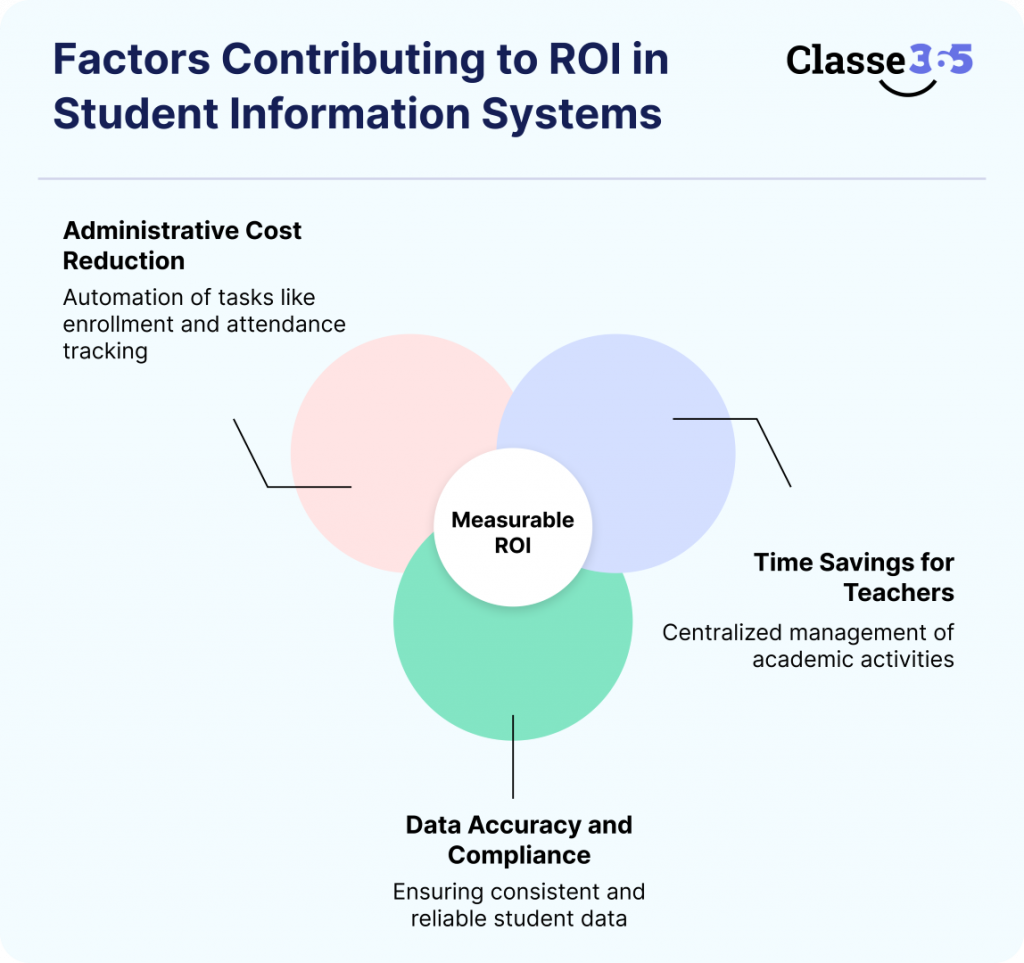
Administrative Cost Reduction Through SIS Automation
The lack of a common SIS would mean that the teams would spend a large amount of time dealing with enrollment, updates, and resolving issues with presence tracking and the multiple systems that the teams have had to establish. All this is eliminated by the presence of the technology offered by Class365.
On average, the institutions that have completely integrated SIS solutions have seen a reduction of 20 to 35 percent in administrative processing time. This alone results in significant payroll savings or the addition of personnel to deal with students.
Time Savings for Teachers and Academic Teams
Faculty productivity also plays an important role in institutional efficiency. When tracking attendance, grading, and reporting are spread over several different systems, faculty time gets impacted.
“Classe365” integrates all academic activities so that teachers can handle class and academic information, as well as reporting and assessments, in a central manner. Research studies have identified that streamlining academic activities with SIS has the potential to save teachers a couple of hours a week.
Data Accuracy, Reporting, and Compliance Savings
Inaccuracies in student data cause variance in reporting, audit risks, and delays in funding. Classe365 provides a source of truth for student data, ensuring consistency in data in all departments and systems.
For institutions following the requirements under the FERPA regulations, the GDPR, or other regional education regulations, optimizing data governance means less time is required for preparing for an audit, hence directly affecting the SIS return on investment.
Understanding Outputs from an SIS ROI Calculator
Once inputs are applied, an SIS ROI calculator produces outputs that help leadership teams assess both short-term and long-term value.
Annual Cost Savings from SIS Implementation
The annual savings come from reductions in administrative manpower, maintenance of the legacy system, as well as corrections. In most institutions, these savings alone account for more than the cost of an SIS subscription in the first year.
SIS Payback Period Explained
The payback period is an estimate regarding the speed of return of investment regarding the SIS. For cloud solutions such as Classe365, the average payback period is estimated to range from 12 to 24 months.
Our results explore how the effect of SIS adoption changes as
The return on investment for SIS over a three-to-five-year period increases as enrollment growth, program development, and system implementations increase. Long-term ROI adds value in terms of improved planning, student outcomes, and decreased reliance on manual processes.
Long-Term Financial Impact of SIS Adoption
Over a three- to five-year horizon, SIS ROI increases as institutions scale enrollment, add programs, and integrate additional systems. Long-term value often includes improved planning, better student outcomes, and reduced dependency on manual processes.
Example SIS ROI Calculation for Schools and Universities
To show how ROI translates into measurable outcomes, consider a mid-sized institution operating with multiple disconnected systems.
Sample SIS ROI Scenario
| Metric | Before SIS | After SIS | Annual Impact |
| Admin hours per year | High manual workload | Automated workflows | Significant reduction |
| Legacy system costs | Multiple tools | Consolidated platform | Lower IT spend |
| Compliance effort | Time-intensive | Centralized reporting | Reduced risk |
| Total annual savings | — | — | Strong positive ROI |
This type of scenario demonstrates why SIS platforms like Classe365 are positioned as operational infrastructure rather than standalone software tools.
SIS ROI for K-12 Schools Using Classroom Management Leaderboard Software
When it comes to K-12 schools and districts, SIS ROI is highly relevant to the subject of enrollment accuracy, attendance management, communication between the school and parents, as well as regulatory reporting.
Classe365 provides a student data management system that can be managed centrally, allowing the districts to streamline data classroom management and enjoy lower overhead costs. ROI comes through faster processing, better attendance compliance, and accurate data entry reports.
SIS ROI for Higher Education Institutions
In the realm of higher education, the SIS ROI continuum spans the entire spectrum, from admissions to academics, financials, as well as alumni business activities. Institutions of higher learning also derive benefits from an integrated information workflow that eliminates silos within the various departments
In fact, the modularity designed in Classe365 enables institutions to expand their use of the platform in faculties, programs, or campuses to ensure return on investment.
Factors That Maximize Student Information System ROI
Institutions receiving the highest ROI from an SIS share common implementation and adoption practices.
Cloud-Based SIS vs On-Premise Systems
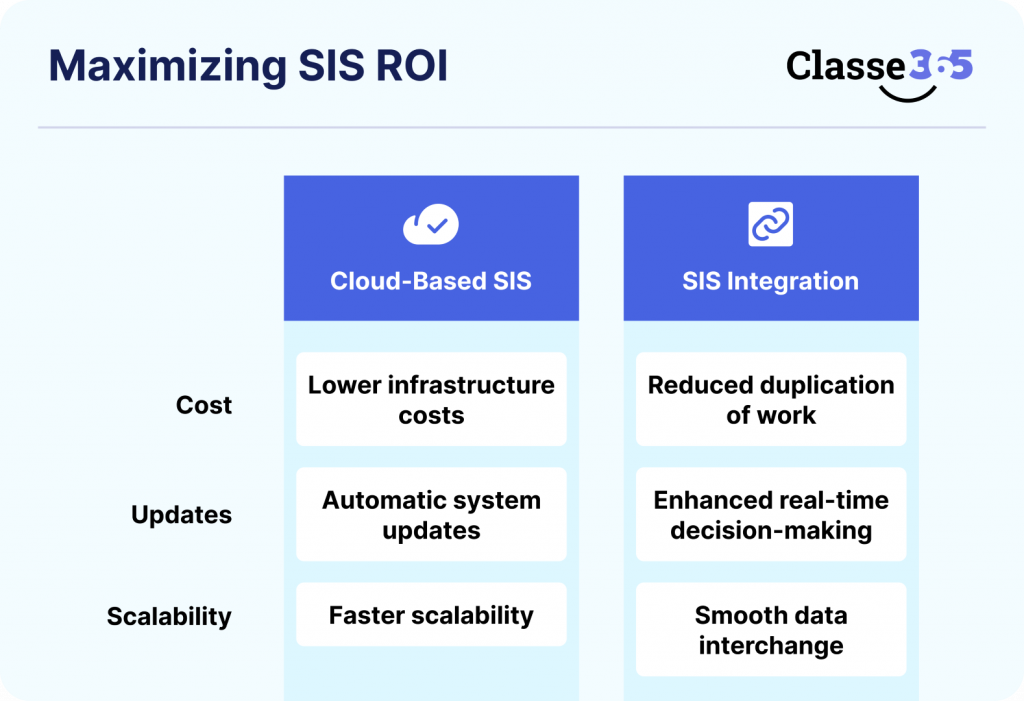
Cloud-based SIS systems offer better returns on investments since the costs related to infrastructure are lower, the system’s updates are automatic, and scalability is faster. Classe365, with its cloud base, ensures that every overhead related to on-premise maintenance of the system is eliminated, thus facilitating an institution to concentrate resources on outcomes rather than upkeep.
SIS Integration Across the EdTech Stack
Integrations elevate the ROI multifold. Classe365 supports standards such as OneRoster and LTI for smooth data interchange with LMS, finance, and CRM systems. This reduces duplication of work and enhances real-time decision-making.
Common Reasons SIS ROI Falls Short
The SIS ROI calculator is much more than a procurement instrument. An SIS ROI Calculator helps with long-term budgeting by integrating technology spending with operational results.
Through modeling, institutions can assess their expansion strategies, integration strategies, and future digital plans with higher confidence.
Application of SIS ROI Calculator in Budget Planning
An SIS ROI calculator is more than just a sourcing instrument. It helps in long-term budgeting by matching technology expenditures with specified business outcomes.
Through simulation, institutions can assess plans for expansion, integration, and future digital initiatives with more certainty.
SIS ROI Calculator vs. Conventional Cost Analysis
Conventional cost analysis is concerned with the cost of the SIS. ROI analysis is concerned with its deliverables.
The value proposition presented at Classe365 is in line with this trend, communicating a positioning of the SIS as an underlying platform for achieving greater efficiency, accuracy, and scalability for the institution.
FAQ
How do schools calculate the ROI for a Student Information System?
Schools determine the SIS ROI by analyzing current administrative costs, personnel hours devoted to manual processes, and existing costs of legacy systems side by side with costs saved post-implementation based on the efficiencies of automation, systems integration, and process improvements. A tool to compute SIS ROI is based on these efficiencies to provide an annual savings value, payoff period, and percentage ROI.
Which are the key factors to measure in the Return on Investment of a Student Information System?
The main ROI areas in SIS are administrative hours saved, avoided costs of using multiple software programs, improved data accuracy, compliance cost savings, and staff productivity. Student enrollment numbers and the use level of the student information system are also determining factors in ROI.
How long does it take to observe ROI for Student Information System?
Typically, most schools and universities can start realizing the SIS ROI within 6 to 18 months of full SIS system implementation. More returns can usually be expected from the cloud-based SIS system solutions.
Does ROI in Student Information System also vary between K-12 institutions and colleges?
Yes. The K-12 SIS ROI tends to vary based on attendance automation, fundingVERTACALaccuracy, and district reporting efficiencies, whereas higher education institutions derive their ROI values from enrollment management cycles and system-wide integration efforts.
Can the SIS ROI also be determined in other respects?
Yes. SIS ROI also encompasses other forms of ROI that would include a better student experience, quicker access to accurate data, improved institutional decision-making, mitigated risks in the area of compliance, and scalability.
What are the hidden costs to factor into an SIS ROI calculation?
Hidden costs: It involves time used in error corrections in data, duplicated work, audit preparation time, costs of non-compliance, as well as maintenance costs of the current technology used. Including these costs will give a realistic return on investment of SIS.
What is the impact of SIS integration on overall ROI?
SIS integration TITANS of getRandom LLC ROI sightfully improve as a result of eliminating redundant data entry and facilitating real-time data syncing between LMS, finance, CRM, and analytics systems. This is made possible and simplified through industry standards such as OneRoster and LTI.
Is a cloud-based Student Information System more cost-effective compared to on-premises alternatives?
Usually, the answer is yes. Cloud SIS systems offer more ROI due to the lack of initial investment, ease of updates, less dependency on IT, and scalability compared to traditional SIS.
To what extent are the ROI calculators available in Student Information Systems accurate?
The SIS ROI calculator works rather well for those institutions that put in realistic information and also take into consideration the depth of implementation. Constant evaluation of assumptions against predictions and actual results helps improve accuracy.
Who can benefit from the Student Information System ROI Calculator?
SIS ROI calculators are designed more for school administrators, financial professionals, IT teams, or boards within the education sector to help review purchase, renewal, or expansion initiatives involving SIS for data-driven budget decisions.