



In 2026, school management software is most often priced per student, typically between $2 and $15 per student per month, though flat-rate plans, per-module pricing, and free tiers also exist. A small school might pay a few hundred dollars a year, while a large institution with many modules can reach five figures annually. Custom-built systems start around $15,000 and rise sharply. There is no single price, because cost depends on how many students you have, which modules you need, and how the vendor charges. This guide breaks down the models, the ranges, and the hidden costs so you can budget realistically.
This article is general cost information, not financial advice. Prices change and vary by vendor, so treat the figures here as ranges to guide your own comparison.
A Few Facts About School Software Costs
- US public schools spend an average of $18,614 per pupil each year, so management software typically accounts for a small fraction of a student’s budgeted cost.
- Per-pupil spending reached $17,619 in fiscal year 2024, the highest on record, according to the US Census Bureau, indicating that IT budgets are growing alongside overall spending.
- The school information management software market is projected to grow from $13.57 billion in 2026 to $21.79 billion by 2031, indicating increased adoption among institutions.
- Implementation and services often cost as much as or more than the first year of software licenses, so the sticker price is rarely the full price.
- Most vendors charge per student, so your cost scales with enrollment rather than remaining fixed.
What Determines the Price of School Management Software?
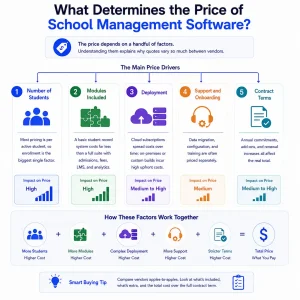
The price depends on a handful of factors, and understanding them explains why quotes vary so much between vendors. The main drivers are:
- Number of students. Most pricing is per active student, so enrollment is the biggest single factor.
- Modules included. A basic student record system costs far less than a full suite with admissions, fees, LMS, and analytics.
- Deployment. Cloud subscriptions spread costs over time; on-premises or custom builds incur high upfront costs.
- Support and onboarding. Data migration, configuration, and training are often priced separately.
- Contract terms. Annual commitments, add-ons, and renewal increases all affect the real total.
What Are the Common Pricing Models?
School management software is sold under a few distinct models, and knowing which one a vendor uses tells you how your bill will behave as you grow.
| Pricing model | How it is charged | Best for |
| Per student | A set rate per active student, monthly or yearly | Schools that want cost to track enrollment |
| Per module | A price for each feature set you enable | Schools needing only some functions |
| Flat rate | One fixed fee for a plan or tier | Small schools wanting predictable cost |
| Freemium or tiered | A free or low base tier, paid upgrades | Very small schools testing the waters |
| One-time or custom | A large upfront build cost plus maintenance | Large institutions with unusual needs |
Subscription pricing dominates because it aligns cost with use and avoids a large upfront outlay. Most cloud platforms, including online school management software delivered over the web, use per-student or per-module subscriptions rather than one-time fees.
How Much Does School Management Software Cost in 2026?
For most schools, the realistic range is a few hundred to several thousand dollars a year, depending on size and modules. Per-student pricing typically ranges from $2 to $15 per student per month. A published example is Gradelink, whose plans range from $297 to $897, plus $5 per active student per year, illustrating how a base fee and a per-student charge combine.
At the higher end, a custom-built system starts around $15,000 and climbs with complexity, faculty size, and integrations. Between those extremes sits the bulk of the market: cloud platforms with modular, per-student pricing. Classe365, for instance, publishes pricing starting at $100 per month for its core modules, covering up to 100 students, with a modular, per-student model and a free trial, which places it in the accessible mid-range for small and growing institutions.
The honest takeaway is that a mid-sized school running several modules should budget in the low thousands per year, while a small school with basic needs may spend only a few hundred. Whatever the model, the school management software price ultimately tracks your student count and the modules you switch on.
What Hidden Costs Should You Watch For?
The subscription fee is rarely the whole story, and the extras are where budgets get blown. Watch for these:
- Implementation and data migration. Moving existing records into a new system is often a separate, significant line item.
- Training. Getting staff up to speed may carry its own fee.
- Add-on modules. A low base price can climb quickly as you enable admissions, fees, or analytics.
- Per-transaction fees. Online payment features sometimes charge a percentage on top of the subscription.
- Renewal increases. The introductory rate may rise at renewal, so ask about multi-year pricing.
These are not hypothetical. Market research notes that services such as implementation, customization, and integration often equal or exceed first-year license fees, so a realistic budget accounts for them from the start.
How Much Does School Management Software Cost by School Size?
Because most pricing is per student, the clearest way to estimate your own cost is by size. The table below gives rough annual ranges for cloud software on per-student or tiered plans, before implementation and add-ons.
| School size | Typical students | Rough annual software cost |
| Small school | Up to 200 | A few hundred to about $2,000 |
| Mid-sized school | 200 to 1,000 | About $2,000 to $10,000 |
| Large school or district | 1,000 to 5,000+ | $10,000 into five or six figures |
| Custom or multi-campus | Varies | $15,000+ upfront plus ongoing |
Two caveats keep these honest.
First, these are subscription figures only; implementation, migration, and training sit on top.
Second, per-student pricing does not scale in a perfectly linear way because many vendors lower the per-student rate as enrollment increases. Treat the range as a starting point, then get a quote against your exact numbers.
How Do You Get the Best Value, Not Just the Lowest Price?
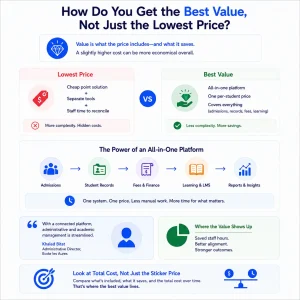
The cheapest option is not always the most economical, because value depends on what the price includes and what it saves. A slightly higher subscription that replaces several separate tools can cost less overall than a cheap point solution plus the staff time to reconcile it with everything else.
This is the case for an all-in-one platform: one per-student price covering admissions, records, fees, and learning often beats paying for and stitching together separate systems. The value appears as saved staff hours rather than a reduced invoice. Khaled Bitat, Administrative Director at Ecole les Aures, notes that with a connected platform, administrative and academic management is streamlined, which is where the real return sits. To weigh cost against those savings for your own school or university, compare the full picture rather than the headline rate, as the complete guide to student information systems lays out. For the administrators who own the budget, that total-cost view matters more than the sticker price.
Estimate Your Own Cost and Savings
Rather than guessing, enter your numbers and see the return. Use the Classe365 ROI calculator to estimate how much a connected platform could save your institution compared to your current setup.
FAQ
Is there free school management software?
Yes, some vendors offer free tiers or open-source options, but these usually limit the number of students, modules, or support. Free tools can suit a very small school, though most growing institutions outgrow them and end up paying for capacity, integration, or support.
Is per-student or flat-rate pricing better?
It depends on size and growth. Per-student pricing suits schools that want cost to track enrollment and start low when small. Flat-rate pricing gives predictable budgeting and can be cheaper at higher student counts. Compare both against your actual numbers.
Can the pricing for school management software be negotiated?
Often, yes, especially for larger enrollments or multi-year commitments. Vendors may discount the per-student rate, waive setup fees, or bundle modules. It is worth asking, since published pricing is frequently a starting point.
How much should a small school budget?
A small school with basic needs can often start in the low hundreds of dollars per student or per entry tier. The figure rises with each added module, and as enrollment grows, so does the budget for expansion, not just the starting price.
Does online software cost more or less than on-premise?
Online school management software usually costs less upfront because there is no hardware or large one-time license, though you pay ongoing subscription fees. On-premises solutions carry high upfront costs but no recurring license fees, which can suit institutions with strict data residency requirements.
What is usually included in the base price?
Typically core student records and a limited set of features. Admissions, fee management, an LMS, analytics, and integrations are often add-ons. Always confirm exactly which modules the base tier covers before comparing two quotes.
Why do quotes vary so much between vendors?
Because they price different things. One quote may be per student for records only; another, a flat rate for a full suite. Comparing them fairly means normalizing for student count, included modules, and setup fees.
What does it cost to switch systems later?
Switching entails data migration effort, retraining, and potential overlap while both systems are running. Choosing a platform that fits your needs and scales with you is cheaper than migrating again in a few years, which is why fit matters as much as price.