




Enrollment is the broad status of being admitted and active at an institution. Registration is the specific act of signing up for courses. The clearest way to see it is an example: a student is enrolled at a university for the academic year, which is their standing as an active student, and each term that same student registers for individual classes like Biology 101 and Statistics 200.
You enroll once to become a member of the institution. You register every term to build a schedule.
That difference between registration and enrollment holds cleanly in higher education. It blurs in K-12 and in other systems, which is the source of most of the confusion. This guide explains both terms, where they differ, where they overlap, and why the difference matters in practice.
What Does Enrollment Mean in Education?
Enrollment is the status of being formally admitted to and active at an institution. The meaning of enrollment centers on belonging: an enrolled student has a place at the school, a student record, and the right to access the school’s programs.
Enrollment usually happens once at the start of a student’s relationship with the school, after admission, and is then maintained or renewed each year. It is the umbrella status that everything else sits under. So what is enrollment in practical terms? It is the answer to the question “Is this person currently a student here?” That broad enrollment meaning stays constant, while a student’s specific courses change every term beneath it.
What Does Registration Mean in Education?
Registration is the process of selecting and enrolling in specific courses within a term. Where enrollment is the standing, registration is the transaction that fills it with actual classes. When someone asks what registration is, the answer is the process of choosing courses, confirming a seat in each, and building a schedule for an upcoming term.
An enrolled student completes registration to secure their courses each semester, quarter, or trimester. It is bounded by deadlines, seat limits, and prerequisites, which is why registration periods open and close on set dates. Put simply, what is registration in practice is the recurring step that turns a standing enrollment into an actual timetable. A student who misses registration may still be enrolled at the institution, but without a class schedule for that term.
What Is the Difference Between Registration and Enrollment?
The core difference is scope and frequency: enrollment is your ongoing status at the institution, while registration is the per-term act of signing up for courses. The table below sets the enrollment-registration distinction out directly.
| Aspect | Enrollment | Registration |
| What it is | Status of being an active student | Act of signing up for courses |
| Scope | The whole institution or program | A specific term’s classes |
| Frequency | Once, then maintained or renewed | Every term |
| Comes after | Admission | Enrollment |
| Result | You belong to the institution | You have a class schedule |
| Bounded by | Academic year or program | Registration deadlines and seat limits |
Why Do These Two Terms Get Confused So Often?
The terms get used interchangeably because the distinction genuinely changes by context, and pretending there is one universal rule is where most explanations go wrong.
In K-12, “enrollment” and “registration” usually mean the same thing: the act of enrolling a child in school. A parent “enrolls” or “registers” their child; both terms describe the single event of joining the school. There is no separate term-by-term course signup the way there is in higher education, so the two words collapse into one.
In higher education, the split is real and matters. The terms also blur across countries and systems, where the same word can mean admission in one place and course signup in another. Even within one system, edge cases stretch the definitions. Dual enrollment, which the U.S. Department of Education’s research arm defines as high school students earning college credits through a postsecondary institution, uses “enrollment” to describe a status that overlaps two institutions at once.
Which Comes First, Enrollment or Registration?
Enrollment comes first. The standard sequence runs admission, then enrollment, then registration, and then re-registration each term after that. A student is admitted when the institution offers a place, becomes enrolled when they accept and activate their student status, and then registers for courses once enrolled.
The order is not interchangeable. You cannot register for courses at an institution you are not enrolled in because registration relies on the enrollment record to verify eligibility, prerequisites, and standing. This dependency is exactly why the two are easy to conflate, and why keeping them connected in one record matters.
How Does Classe365 Handle Enrollment and Registration as One Connected Flow?
In a manual setup, admission, enrollment, and registration live in separate places: an admissions spreadsheet, a student database, and a course signup form that do not talk to each other. That separation forces staff to re-enter the same student three times and is a major reason the terms feel disconnected. Classe365 keeps them as stages of one student record, where enrollment comes first, and registration builds on it. Here is how each works.
How Does Enrollment Work in Classe365, Step by Step?

Enrollment is the first half of the flow, turning an applicant into an active student on record.
- A prospect applies through pre-admission. The applicant submits an online application through pre-admission and enrolment, capturing their details once at the source.
- Application and fees are handled online. Online application forms and online fee payment complete the intake without paper or manual entry.
- The institution enrolls the student in one click. Classe365 offers one-click enrolment by three routes: the website admission form, the eCommerce module with courses set up as products, or the agent module for bulk applications.
- Form mapping populates the SIS automatically. The application data flows straight into the student information system through form mapping, with no re-keying, helping avoid most enrollment errors.
- The student now holds an active enrollment status. That status is the umbrella record everything downstream reads from, and it stays constant while courses change each term.
How Does Course Registration Work in Classe365, Step by Step?
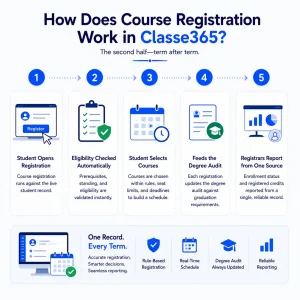
Registration is the second half, run term after term against the enrollment record created above.
- The enrolled student opens registration. Course registration runs against the live student record, so only enrolled students can register.
- Eligibility is checked automatically. Prerequisites, standing, and eligibility are validated from the enrollment record rather than looked up by hand, which prevents invalid registrations.
- The student selects courses within the rules. Registration adheres to seat limits and deadlines, building a schedule of courses to be delivered through the learning management system.
- Registered courses feed the degree audit. Each registration updates the degree audit, so course signups are tracked against graduation requirements in the same place rather than as a separate transaction.
- Registrars report from one source. With both processes on one record, registrars report enrollment status and registered credits from a single source instead of reconciling several systems.
Why Does Keeping Registration and Enrollment in One Record Matter?
Because the enrollment registration flow shares one record, the institution gets one consistent answer about every student, which is what registrars and administrators rely on for reporting. That consistency has real downstream effects. U.S. Federal Student Aid ties aid eligibility to full-time or part-time status, which depends on the number of registered credits, so an incorrect number in a disconnected system can affect a student’s funding. Both records are also protected under privacy rules like FERPA, making one access-controlled source a compliance benefit as well as an operational one. This is the logic behind an all-in-one platform, where the full student journey is one connected flow, as the complete guide to student information systems explains in depth.
If your admission, enrollment, and registration data live in separate systems, book a Classe365 walkthrough to see them working as a single student record.
Frequently Asked Questions
Can a student be enrolled but not registered?
Yes. A student can maintain active enrollment status at an institution without being registered for any courses in a given term, for example, during a leave or before a registration deadline. Enrollment is the standing; registration is the per-term course signup.
What is open enrollment versus open registration?
Open enrollment usually refers to a period or policy that allows students to join an institution without selective admission, while open registration refers to the window during which enrolled students can sign up for courses. One concerns joining the school; the other concerns choosing classes.
What is re-enrollment?
Re-enrollment is the process of renewing active student status, typically each academic year, to keep a continuing student on the rolls. It differs from registration, which a re-enrolled student still does separately for each term’s courses.
Does enrollment status affect financial aid?
Yes. Aid programs classify students as full-time, part-time, or less than half-time based on registered credits, and award amounts are often prorated to that status. A change in registration can therefore change a student’s aid.
What is dual enrollment?
Dual enrollment lets a high school student take college-level courses and earn college credit while still in high school. It is called “enrollment” because the student holds a status at the college, often alongside their high school enrollment.
Is withdrawing from a course the same as unenrolling?
No. Withdrawing from a course removes one class from a term’s registration while the student stays enrolled at the institution. Unenrolling, or full withdrawal, ends the student’s enrollment status entirely.
Why might a registration be blocked while a student is enrolled?
Institutions place holds for reasons like unpaid fees, missing documents, or advising requirements. The student remains enrolled, but the hold prevents registration until it is cleared.
Do “enrollment” and “registration” mean the same thing in K-12?
Often, yes. In most K-12 settings, enrolling and registering are treated as a single act: signing a child up for school, because there is no separate per-term course registration as there is in higher education.